



100v line vs. Low Impedance audio – What’s the difference?
What is 100v Line Audio?
Or 70v line in the US, also known as High Impedance or Constant Voltage.
This is the most common distributed sound system for commercial applications, particularly public address (voice) and background music.
Ideal for long distance distruibution of large numbers of loudspeakers with a relatively low power output.
100v line has a more limited frequency range than low impedance audio, which is the reason for it’s popularity for voice and low level music applications. However, with this frequency range limitation, 100v line is not suitable for foreground, high power or hifi music reproduction.
What is Low Impedance Audio?
Also referred to as Low Z, 8ohm / 4 ohm or Direct Coupled.
Used for residential hifi and surround sound, foreground music and live performance music applications where the full frequency range is required – ie the crisp high frequency range of the tweeters and the lowest frequencies for the bass.
Comparing Low Impedance & 100v Line Systems
Low impedance (Low Z, 8ohm / 4 ohm or Direct Coupled) lines are used normally in the case of a low number of loudspeakers, placed at a minimum distance from the amplifier of less than 20 metres.
In contrast 70 / 100v line voltage connection systems (ie. High Impedance or Constant Voltage) offer a host of advantages making it ideal for sound systems of all sizes, above all in the case of long distance speaker runs.
This connection system requires each loudspeaker to be equipped with its own line transformer, which adapts the impedance of the loudspeaker (usually very low) to the much higher level of the line itself. In proportion to power transmitted, the current circulating on a line at 100v is considerably lower than that circulating on wires of a constant impedance system and consequently, drops along the line are less frequent; therefore the cable gauge can be lower.
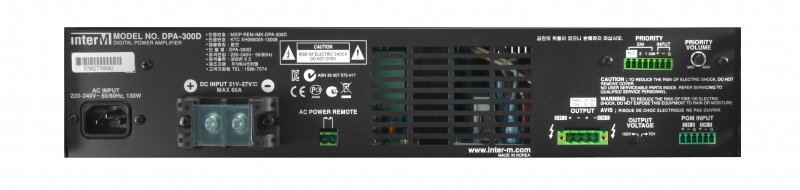
The function of the amplifier device is to raise the signal of a sound source, such as a microphone, CD player, MP3 player or an AM/FM tuner to a sufficient level. The amplifier has several inputs, to which the various sound sources are connected.
The sound sources have to be mixed (mixer) and acoustically modified with tone control and equalisers to optimise listening in relation to the environment’s characteristics. A terminal board is also fitted on output indicating impedance and voltage to which the loudspeaker line is connected.
A few basic rules must always be observed
1. When the load is on ‘constant impedance’; it must be connected to the relative socket.
- For example, a load of 4Ω must be connected to a socket marked 4Ω, and so on. The power that the load can withstand must always be greater than the amplifier’s rated power.
- For example in the case of a load of 100W, the amplifier must have a power equal to or less than 100W.
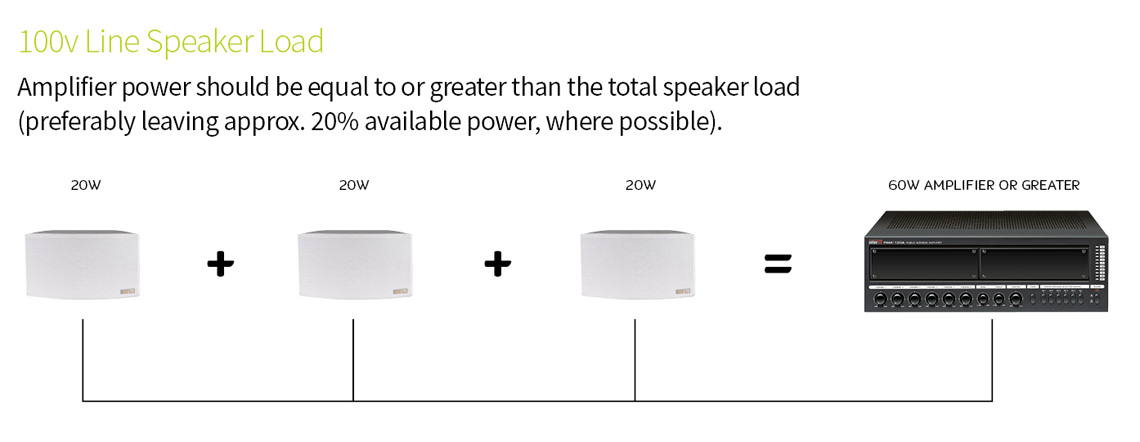
2. When the load is at ‘constant voltage’; it must be connected to the sockets indicating output at constant voltage – 50, 70 or 100v; the power that the load can withstand must always be less than or equal to the amplifier rated power.
- For example, with a load of 100W, the amplifier must have a power equal to or greater than 100W.
- To calculate the required value of a 100v line amplifier power, simply add together the power, simply add together the power of each loudspeaker. (see figure below).
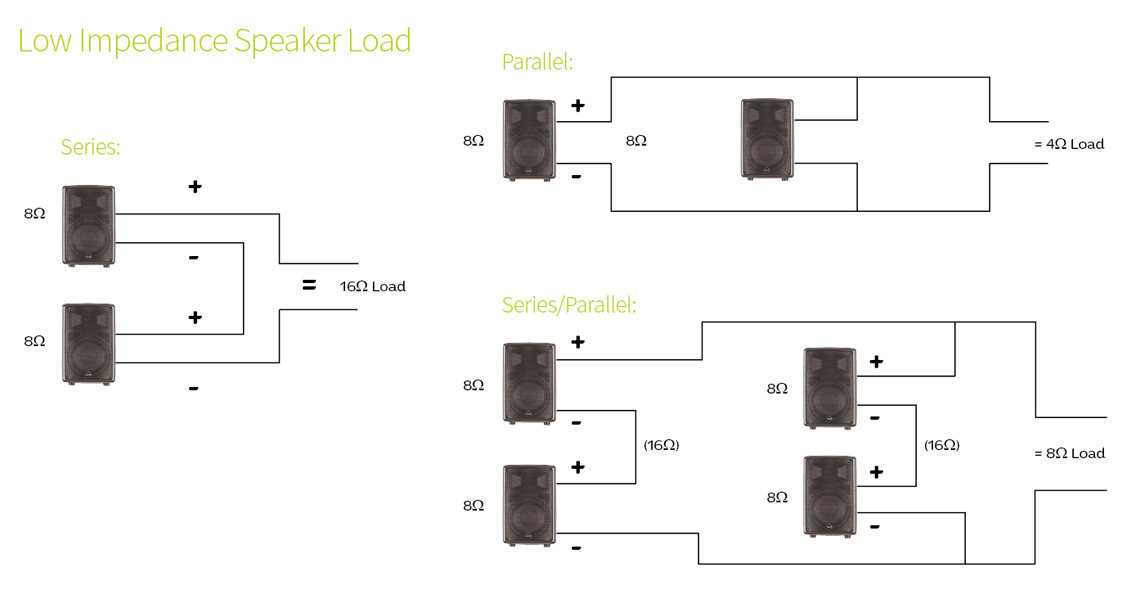
However, on a constant impedance system, the load must have an equivalent impedance (series/parallel) equal to or greater than the minimum value indicated on the amplifier output.
The loudspeaker power supply lines, with no connected attenuator, must be with 2 sheathed wires; cables with 3 sheathed is activated. Adequate wire sections are required:
1.5mm2 for lines up to 500W power, 2.5mm2 for lines with power over 500w. The following general standards must also be observed.
- Never use a single cable (lead) for loudspeaker connections: this would cause disturbance producing a loud ‘HUM’
- Never use shielded cables for the loudspeaker connections: this would cause serious damage to the power units.

